Contact
 en / €

No products found.

Zind-Humbrecht wine estate
For centuries, the Humbrecht family has crafted exceptional wines in Alsace , but it was in 1959 that Domaine Zind Humbrecht was born, the fruit of the union of the Humbrecht and Zind wine estates. Winemakers from father to son since 1620,...

Filter products
Filters
Long description
For centuries, the Humbrecht family has crafted exceptional wines in Alsace, but it was in 1959 that Domaine Zind Humbrecht was born, the fruit of the union of the Humbrecht and Zind wine estates. Winemakers from father to son since 1620, Léonard Humbrecht and Geneviève Zind built a modern estate in Turckheim, in the heart of the Herrenweg vineyard, passionately sharing one ambition: to show the strength of Alsace's terroir through powerful, racy wines.
Transmission is at the heart of the family history. Since the 1980s, Olivier and Margaret Humbrecht have run the wine estate, joined in 2019 by their son Pierre-Emile. Olivier Humbrecht distinguished himself as France's first Master of Wine, and embodied demanding know-how. Under his influence, the wine estate became a pioneer in biodynamic vi ticulture in 1997, tracing a philosophy resolutely focused on respect for nature and the enhancement of the soil.
Domaine Zind Humbrecht 's rigorous vision of terroir-based viticulture is rare in Alsace. The conversion to biodynamic viticulture, begun in 1997 and certified in 2002, was not a simple orientation, but a genuine philosophical commitment. Each parcel is worked by hand, according to its own rhythm. Yields are deliberately low, often below Grand Cru standards, to allow the personality of each soil to be fully expressed. Vineyard management is based on a balance between observation and minimal intervention: respectful ploughing with horses, home-made compost, treatments based exclusively on natural preparations, with no synthetic inputs. Pruning was completely rethought in the mid-2000s to preserve the moderate vigor of the vines and ensure natural aeration. This precision approach means that the wine estate never standardizes its practices, adapting them each year, plot by plot, to the conditions of the vintage. It's an artisanal approach that enables each cuvée to faithfully reflect the identity of its terroir.
In the cellar, the same rigorous approach prevails. The grapes are pressed whole, very slowly, sometimes for 12 to 24 hours, to extract the juice gently and without oxidation. No yeast is added: fermentations are carried out exclusively by indigenous yeasts, sometimes over several months, in large old oak foudres that do not mark the wines but ensure slow, controlled oxygenation. The temperature is not artificially regulated, leaving each cuvée to evolve at its own pace. Ageing, often prolonged on lees, refines the structure of the wines while respecting their aromatic integrity. Sulfur is used sparingly, only when necessary, always with a view to protection without make-up. Each decision is taken by tasting, without any pre-established recipe, reflecting the constant quest for accuracy and understanding of the terroir. At Zind Humbrecht, winemaking does not mean correcting: it means accompanying, without ever betraying what the vine has given.
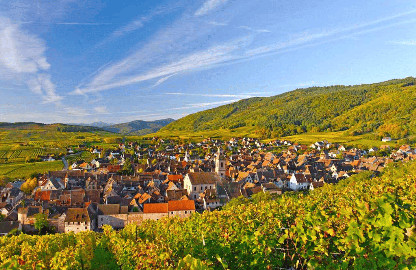
The wine estate works a mosaic of parcels spread over six communes: Turckheim, Wintzenheim, Gueberschwihr, Hunawihr, Niedermorschwihr and Thann, covering 40 hectares, more than half of which are classified as Grand Cru Alsace. Each parcel on the wine estate becomes a laboratory for the expression of terroir, where geology, climatology and the work of the winemaker combine to sublimate the grape varieties and reveal the profound identity of anthological parcels.
Grand Cru Rangen de Thann, at the southernmost tip of Alsace, lies on volcanic ash and grauwackes, producing wines with smoky minerality and great verticality. In the heart of this mountain, Clos Saint Urbain, the estate's monopoly since 1977, has become an emblematic reference. Planted with Riesling, Pinot Gris and Gewurztraminer grapes, this dramatic Clos stands out for its power, depth and singular mineral energy, directly linked to the volcanic rock of the site.
The Grand Cru Brand in Turckheim benefits from highly draining biotitic decomposed granite. On this sun-drenched terroir, which was one of Alsace's first recognized Grands Crus, Riesling Grand Cru Brand develops a noble breadth, carried by fine bitters and vibrant tension. The wine expresses floral and mineral richness, sustained by an energy that makes it both gastronomic and exceptionally well-suited to ageing.
The Grand Cru Sommerberg in Niedermorschwihr, which joined the wine estate in 2010, is an extremely steep terroir (up to 45%), featuring southeast-facing granite arenas. The Sommerberg Riesling Grand Cru is saline, long, with bright acidity and hints of citrus and dried herbs, and is particularly tight-knit in its youth.
Rarer in the Domaine Zind Humbrecht range, the Grand Cru Goldert, in Gueberschwihr, rests on deep oolitic limestone, which lends its Muscat Grand Cru Goldert cuvées an aromatic nobility and chalky verticality far from the grape variety's standards.
Finally, on the limestone marl slopes over Oligocene conglomerates of the Grand Cru Hengst, in Wintzenheim, a rare and precious Pinot Gris is born, with extraordinary concentration, especially in Sélection de Grains Nobles. Powerful, balanced by an imposing acid structure, it combines complexity, controlled botrytis and outstanding ageing potential.
Clos Windsbuhl, perched on a hilltop in the heart of the vineyard, is a perfect example of this. Clos Windsbuhl, perched on the heights of Hunawihr, rests on particularly hard Triassic shell limestone, with a north-easterly aspect that slows down ripening, giving Clos Windsbuhl Riesling cuvées extreme finesse and Clos Windsbuhl Gewurztraminer a refined purity, far removed from the usual varietal exuberance. The Clos Windsbuhl wines are structured, crystalline and salivatingly fresh, even in the sunniest vintages.
Further down in the commune of Wintzenheim, at the foot of the Grand Cru Hengst, the Clos Haüserer Riesling cuvées are steeped in this Keuper limestone terroir. Here, the vines deliver taut wines with a straightforward acidity, whose saline structure brilliantly conveys the wine estate's driest style.
Clos Jebsal, on the other hand, is situated on warm, sunny terraces of Turckheim grey marl and gypsum, with high water retention capacity. This is the realm of Pinot Gris, particularly for Vendanges Tardives and Sélections de Grains Nobles. Clos Jebsal Pinot Gris cuvées are distinguished by their exceptional aromatic concentration, where natural richness and elegance combine with rare precision.
His unwavering commitment to the terroirs of Alsace and his ability to combine agronomic science and winemaking sensibility have made Domaine Zind Humbrecht a benchmark for great European white wines. At the crossroads of historic Alsace and a profoundly contemporary vision, he embodies a form of excellence that inspires far beyond the region's borders. His quest for pure expression, his precision of style and his consistency over time make him a great name in viticulture, whose every cuvée sheds a little more light on the infinite potential of Alsace wines.
Check out our suggestions