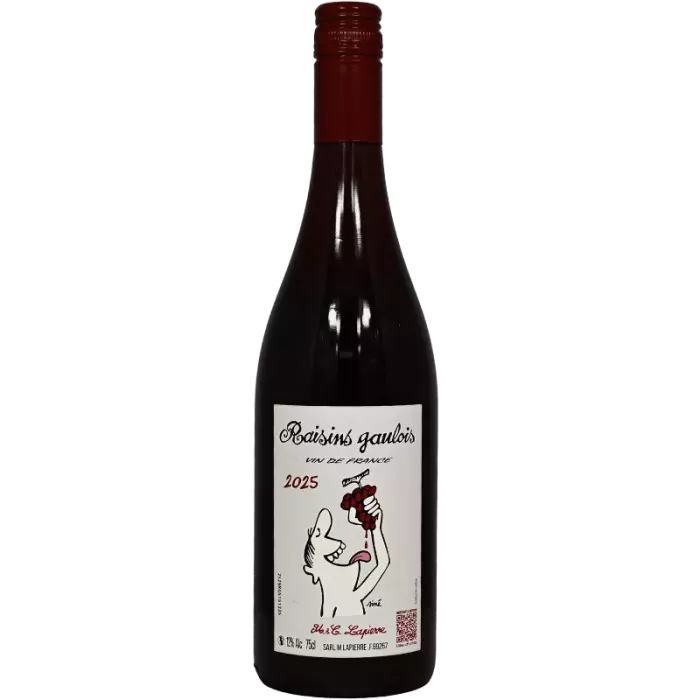
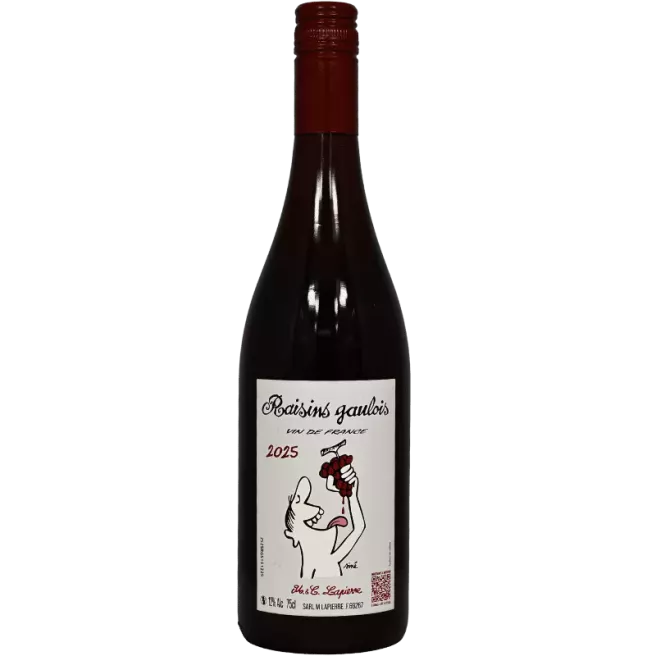
Raisins Gaulois 2025 | Marcel Lapierre
Raisins Gaulois holds a special place in the Marcel Lapierre wine estate’s lineup. Designed to be enjoyed, shared, and savored time and again, it is the estate’s most approachable cuvée—one that can be opened without ceremony and enjoyed with immense pleasure. Marcel Lapierre was one of the great pioneers of low-intervention winemaking in the Beaujolais region, and the wine estate is now run by his children, Mathieu and Camille Lapierre, in the same spirit: minimal intervention, plenty of fruit.
Terroirs and Grape Variety
The Gamay used in this wine comes primarily from young vines in the Morgon area, one of the most renowned crus in Beaujolais. The soils there are granitic and schistose, sandy on the surface, and well-drained. These poor, well-draining soils challenge the vines, naturally limiting yields and concentrating energy in the fruit. Here, the young vines produce a wine that differs from those of the cru: livelier, more direct, and less complex. This is precisely what we’re looking for.
Viticulture and Winemaking
The wine estate is certified organic and also practices biodynamics. The grapes are harvested by hand. Winemaking relies on traditional Beaujolais semi-carbonic maceration, carried out with indigenous yeasts and without any corrective additives. Ageing is brief: two months in stainless steel tanks, just long enough to preserve the freshness without weighing down the fruit. Sulfite levels are kept to a minimum, in keeping with the natural wine philosophy the wine estate has championed for decades. Yields exceed the Beaujolais AOC limit of 56 hl/ha, which explains the “Vin de France” label: a conscious choice, not a compromise.
Raisins Gaulois 2025 | Marcel Lapierre: The Sommelier’s Review
Philippe Mischler, sommelier at Mundovin
This wine makes no pretensions other than to be exactly what it is: a delightful Gamay, straightforward and easy-drinking. Within the Lapierre range, it serves as the entry-level wine, and it does so well. Its effortless drinkability, backed by the wine estate’s natural rigor, makes it one of the most honest reds in Beaujolais. Serve chilled, around 15°C, or even slightly cooler in hot weather. It’s expected to reach its peak drinking period between 2026 and 2028—which is to say, there’s no need to wait.
The Nose
The nose opens with wild strawberries and crisp red cherries, clear and unambiguous. A hint of rhubarb adds a light, very inviting vegetal acidity. Subtle floral notes, reminiscent of peony, punctuate the bouquet. The whole remains bright and light, without any heaviness.
Palate
On the palate, the attack is light and juicy. The texture is supple, almost airy, with very few perceptible tannins. The acidity is lively and crisp; it provides structure without being harsh. The crisp red fruits linger through to a fresh and thirst-quenching finish. An easy-drinking wine, in the best sense of the word.
 en / €
 Contact


.svg)
.svg)