Description of Cuvée No. 749 | Champagne Jacquesson
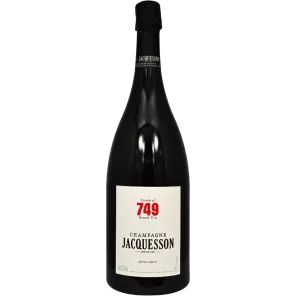
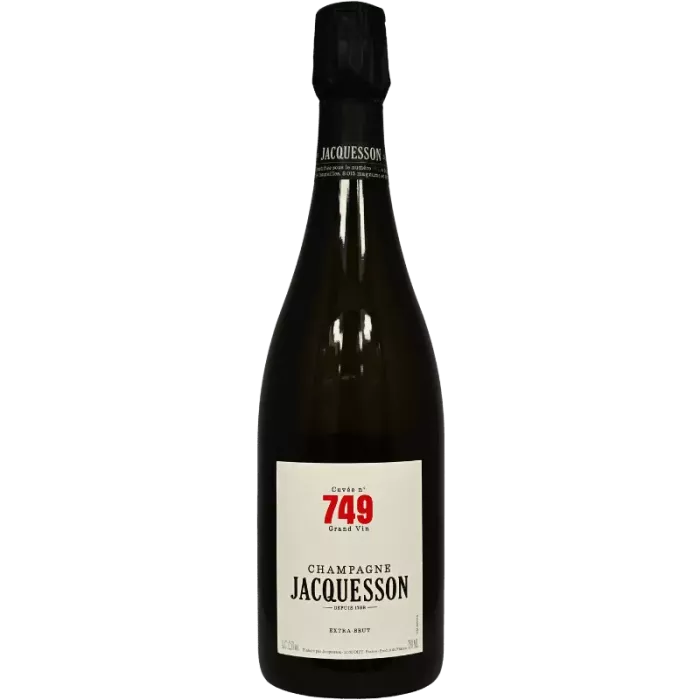
Jacquesson ’s Cuvée No. 749 is a true statement of the house’s philosophy. Ever since the House abandoned the traditional vintage labeling in favor of a continuous numbering system, each cuvée tells the story of a harvest, a specific intention, and the legacy of the wines the wine estate keeps in reserve for its blends. No. 749 is based on the 2021 vintage, supplemented by 28% reserve wines from cuvées 748 through 743, with the exception of No. 745. At Jacquesson, continuity is elevated to the status of a philosophy.
Terroirs and Grape Varieties
The blend draws from two complementary regions: the Grande Vallée de la Marne and its terroirs of Aÿ, Dizy, Hautvillers, and Champillon, which account for 72% of the blend. The remaining 28% comes from Avize and Oiry, on the Côte des Blancs. The limestone and chalk soils of these terroirs give the blend of Chardonnay, Pinot Noir, and Pinot Meunier its distinctive vertical tension.
Viticulture and Winemaking
The vineyard has been certified organic since 2010. The hand harvest allows for rigorous sorting in the vineyard. Fermentation takes place with native yeasts in oak vats, without filtration or fining. Ageing lasts 12 months on the lees in vats, followed by 36 months on racks, and then at least 6 months in the bottle after disgorgement. The extra brut dosage of 2 g/L adds balance without compromising the purity of the aromas.
Cuvée No. 749 | Champagne Jacquesson: The Sommelier’s Review
Philippe Mischler, sommelier at Mundovin
Jacquesson’s numbering system is often misunderstood. This is not a non-vintage blend in the conventional sense, but a meticulously crafted composition built around an identified base, enriched by perpetual reserves. No. 749 follows this philosophy with all the exacting standards characteristic of this great house. With a minimum of 48 months of ageing before release, this Champagne arrives in the bottle already well-structured. It’s no surprise that it has already reached its peak drinking period: it can be opened right now, provided it is served at 9 °C in a generous glass rather than a narrow flute. It will improve with age, with an ideal tasting window lasting at least until 2032.
The Nose
The nose opens with fresh citrus notes, complemented by a subtle, almost powdery floral touch that reveals the Chardonnay’s character. The overall impression is precise, restrained, and delicately refined.
Palate
On the palate, the finesse of the bubbles carries a tight, almost tapered structure that nonetheless possesses good body: the Pinot Noir provides just the right amount of flesh to balance the sharpness of the acid structure, which is invigorating in just the right way. The finish is long and savory, with a notable mineral persistence that evokes the chalky soils of the Côte des Blancs.
Champagne: Everything You Need to Know About This Appellation
Champagne is one of the most strictly regulated appellations in the world. It spans several distinct regions: the Montagne de Reims, the Marne Valley, the Côte des Blancs, and the Côte des Bar. Each region brings a distinct character. Chalky soils dominate the great terroirs, providing drainage, root zone coolness, and characteristic minerality. The authorized grape varieties are primarily Chardonnay, Pinot Noir, and Pinot Meunier.
By blending wines from both the Marne Valley and the Côte des Blancs, Jacquesson demonstrates how these terroirs complement one another. The result is a Champagne with character, immediately recognizable as an expression of a great house.
 Contact
 en / €

.svg)
.svg)