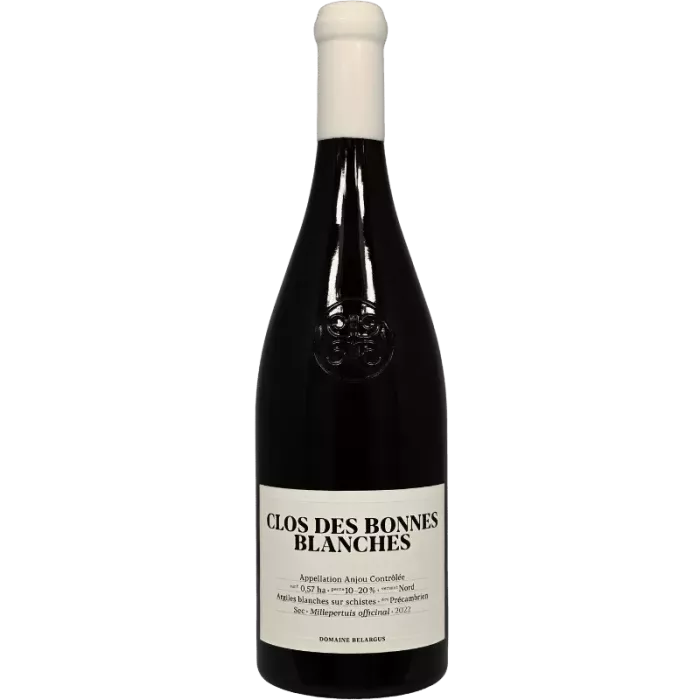
Description: Anjou Clos des Bonnes Blanches 2022 | Domaine Belargus
The Clos des Bonnes Blanches 2022 is one of Domaine Belargus’s most eagerly anticipated single-vineyard wines. It is produced in Saint-Lambert du Lattay, in the heart ofthe Anjou Noir region, on a plot that has long been cultivated for its unique potential. The estate was founded in 2018 by Ivan Massonnat with a clear goal: to restore the prestige of Anjou’s thousand-year-old vineyards. The approach is deliberately plot-based, inspired by Burgundy’s “climats.” Each cuvée tells the story of a specific soil, exposure, and growing season.
Terroir and Grape Variety
The Clos des Bonnes Blanches rests on a soil of talc-rich schist, clay, and white quartz pebbles. The subsoil, composed of dark schist dating back some 500 million years, outcrops beneath a layer of white quartz and rounded pebbles. The plot has a gentle north-facing slope, which gives it a cool, late-ripening character. This exposure preserves aromatic freshness and promotes slow, precise ripening. The vineyard is planted exclusively with Chenin Blanc—100%. On this cool, mineral-rich terroir, it produces wines that are introspective rather than exuberant. The 2022 vintage, sunny and warm, could have thrown this delicate profile off balance. The north-facing slope acted as a buffer. The result is opulent fruit ripeness, supported by intact mineral tension.
Viticulture and Winemaking
The estate is managed biodynamically and has been certified organic since 2022. Harvesting is done by hand, in successive passes, to select only grapes at optimal ripeness. Fermentation takes place using only the indigenous yeasts present on the berries. Aging lasts three years in demi-muids, vessels that preserve the wine’s minerality without imposing a dominant oak character. There’s no rush at this estate: the wine develops at its own pace, under the guidance ofAdrien Moreau, with advice from Jo Pithon and Guy Bossard.
Anjou Clos des Bonnes Blanches 2022 | Domaine Belargus: The Sommelier’s Review
Philippe Mischler, sommelier at Mundovin The Clos des Bonnes Blanches holds a special place in the estate’s lineup. It is a wine of introspection, not of showmanship. The plot’s north-facing orientation—rare in Anjou—gives it a verticality that few dry whites from the region possess at this level. The 2022 vintage, a sunny one, has produced a wine here that is more generous than usual, yet without losing its integrity. This Chenin grown on talc-rich schist should be cellared until 2039: it has not yet reached its full potential. Serve at around 10 to 12°C, paired with scrambled eggs with porcini mushrooms or grilled lobster with lightly salted butter.
The Nose
The nose opens with ripe yellow-fleshed fruits, apricot, and roasted pear. Notes of fresh honey accompany these, without weighing the wine down. A floral touch creeps into the background, with a slight hint of fennel. What really catches the attention is the salty, slightly smoky quality that runs through the entire profile. It reflects both the schist terroir and the winemaker’s touch.
On the palate
On the palate, the attack is round, almost enveloping. The body is opulent for a dry white from the Loire. The fine acidity provides structure without harshness, carrying the wine toward a crystalline, long finish. A mineral salinity runs through the entire tasting experience, from the attack to the finish. The balance between richness and tension is the hallmark of this vintage on this cool terroir.
The Anjou appellation: a rediscovered millennia-old terroir
The Anjou appellation has its roots in the Armorican Massif, whose dark schists form the geological backbone of the Anjou Noir. This chaotic mix of 500-million-year-old rocks—a blend of purple schist, wind-blown sand, and fine clay—shapes wines of rare minerality and complexity. Chenin Blanc is the region’s quintessential historic grape variety. Served at royal tables until the 19th century, Anjou whites endured a long period of obscurity before experiencing a renaissance spearheaded by a handful of discerning winemakers. Le Clos des Bonnes Blanches epitomizes this revival. Grown on a plot whose potential has long been recognized, it expresses the clarity and precision that only the finest terroirs of Anjou Noir are capable of producing. Domaine Belargus’s plot-by-plot approach restores to this appellation the distinctiveness and prestige it should never have lost.
 en / €
 Contact


.svg)
.svg)