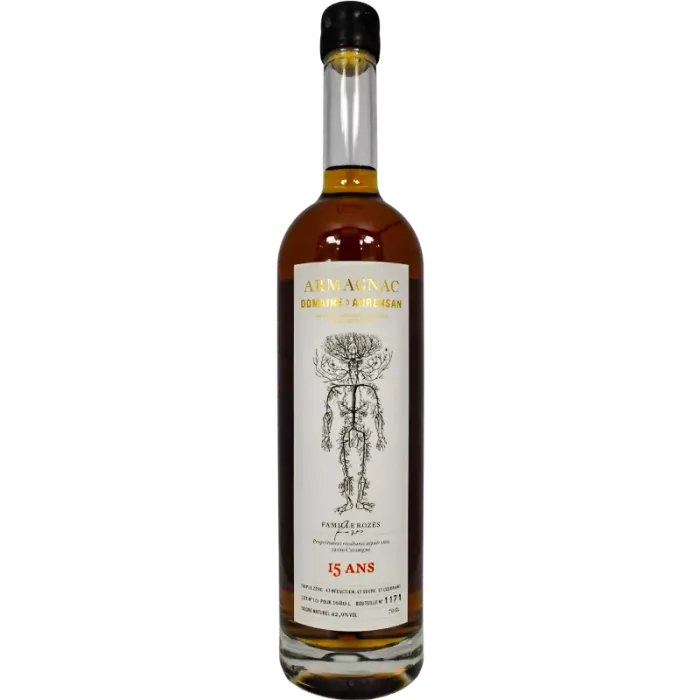
15-Year-Old Armagnac | Domaine d'Aurensan
Domaine d'Aurensan is a family-owned wine estate that has been based in Ténarèze, in southwestern France, since the late 19th century. Here, there is no buying in or outsourcing: every step, from the vineyard to the bottle, remains in the hands of Bernard Rozès and his two daughters, Sophie and Caroline. The vineyard spans 8 hectares, planted with the 10 historic grape varieties of Armagnac. A one-of-a-kind rarity in the region! This 15-year-old Armagnac is a blend of different vintages, aged in oak barrels made from trees on the wine estate itself.
Terroir and Grape Varieties
The Ténarèze region occupies a central position within the appellation. Its clay and chalk soils retain moisture deep underground, forcing the roots to grow deep. This balance between richness and subtle drainage produces eaux-de-vie with more structure than those from Bas-Armagnac. The blend is based primarily onUgni Blanc, complemented by Colombard and Folle Blanche—three grape varieties with high natural acidity, ideal for distillation.
Distillation and Ageing
Distillation is carried out continuously, following the traditional Armagnac method.Ageing lasts 15 years in oak barrels crafted from wood sourced from the wine estate’s own oak trees. This detail is significant: the wine estate’s own wood imparts a softer, more integrated oak character. No sugar, no coloring, no dilution: the wine estate proudly bears the “Triple Zero” designation, and bottling is done at natural proof. Each batch is unique. Bernard Rozès does not seek a consistent taste, but rather the best possible composition for each age category.
15-Year-Old Armagnac | Domaine d’Aurensan: The Sommelier’s Review
Philippe Mischler, sommelier at Mundovin
This 15-year-old Armagnac offers a remarkable balance between freshness and maturity. Yet this is a delicate balancing act: if the blend is too young, it can lack body and veer toward acidity; if too old, it can lose its fruity vibrancy. Here, the balance is just right. The “Triple Zero” philosophy is a statement of intent: what’s in the glass comes solely from the raw ingredients. I recommend serving it slightly warmed to room temperature—around 18–20°C—in a tulip-shaped glass that perfectly concentrates the aromas. It stands on its own, best enjoyed neat in small sips. Those with a more indulgent palate can try pairing it with a richly braised red meat: success guaranteed!
The Nose
The nose opens with notes ofcandied apricot and dried fruit, with almonds taking center stage. Vanilla emerges gently, carried by the wine estate’s oak. Mild spices follow, subtle yet distinct. The overall impression is bright and light, without any heaviness.
Palate
On the palate, the attack is round and supple. The body is rich and well-balanced, without excess. The structure holds up over time, with a lingering finish featuring spicy notes—long and smooth. Nothing overpowers. This is a spirit that knows how to conduct itself.
Armagnac: Everything You Need to Know About This Appellation
Armagnac is France’s oldest wine spirit, produced in Gascony, in the southwest. Its uniqueness lies in continuous distillation in column stills, which preserves more aromatic compounds than the double distillation method used in Charente. The appellation is divided into three zones: Bas-Armagnac, Ténarèze, and Haut-Armagnac. There are only a few authorized grape varieties: Ugni Blanc, Colombard, Folle Blanche, and a few historic varieties. Aging in oak barrels is mandatory and forms the core of the style. Domaine d’Aurensan adheres to this tradition with particular rigor. Ten grape varieties grown on 8 hectares in Ténarèze, barrels crafted from the wine estate’s own oak trees, and a policy of producing a single cuvée: these are the choices that set this wine estate apart in an appellation where standardized blending remains the norm.
 en / €
 Contact


.svg)
.svg)