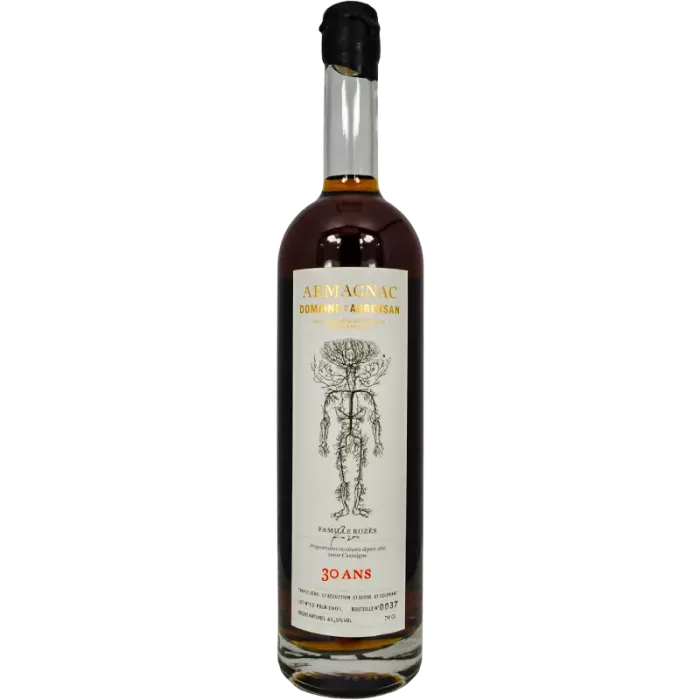
30-Year-Old Armagnac | Domaine d'Aurensan
Domaine d'Aurensan’s30-Year-Old Armagnac is an artisanal brandy, crafted from grapes grown on an 8-hectare vineyard with the clay-limestone soils typical of the Ténarèze region. The family has owned and cultivated the vineyard since the late 19th century: for four generations, every bottle has come from this nourishing land, from the same barrels, crafted by the same hands. The blend combines several small batches, aged in a single oak barrel for at least thirty years. This winemaker’s Armagnac celebrates the uniqueness of each batch.
Terroir and Grape Varieties
Ténarèze is the central region of Armagnac, renowned for its structured eaux-de-vie with excellent aging potential. The clay-limestone soils retain moisture, temper the vines, and promote high natural acidity. This acidity is invaluable: it imparts to the distillate a lively, taut character, built to stand the test of time. The Aurensan vineyard is one of a kind. It includes all 10 of Armagnac’s historic grape varieties, six of which had nearly disappeared but were replanted by the family to reconnect with the appellation’s original flavor.Ugni Blanc dominates the blend—a high-acidity, low-sugar variety ideal for distillation.
Viticulture and Winemaking
The harvest is done by hand, at the ideal stage of ripeness for distillation: high acidity, moderate sugar content. Winemaking is natural, with no added yeast or sulfur. Distillation takes place in column stills, the traditional Armagnac method. Ageing lasts at least thirty years in traditional 420-liter barrels (known as “pièces”) made from oak trees on the estate. The wood comes from the same land as the grapes. Bottling is done by hand, upon request, without filtration. This Armagnac is a “Triple Zero ”: no added sugar, no coloring, and no water. It is bottled at its natural alcohol content. The wine estate is certified HVE Level 3 (High Environmental Value) and is transitioning part of its vineyard toorganic farming.
30-Year-Old Armagnac | Domaine d’Aurensan: The Sommelier’s Review
Philippe Mischler, sommelier at Mundovin Thirty years in the barrel is a long time—almost intimidating. In Ténarèze, the clay-limestone soils produce dense eaux-de-vie that hold up better over time than those from other regions. What strikes me here is the wine estate’s philosophy: each batch is different, and embraced as such. No standardization, no caramel added to even out the color. A winemaker’s Armagnac in every sense of the word, faithful to the land, to ten grape varieties, and to thirty years of patience. I serve it at 18°C in a slightly tapered balloon glass to concentrate the aromas without stifling them.
The Nose
The nose opens with generous notes of candied fruit: ripe plum, orange zest. A pastry-like note emerges, almost brioche-like. Sugarcane appears in the background, subtle. After a few minutes, the wood blends seamlessly into the whole. Nothing really dominates. Everything coexists with a quiet ease.
Palate
On the palate, the attack is clean and crisp, without any heaviness. The texture is round and voluptuous, full-bodied without being greasy. The balance rests on a delicate tension, a legacy of the grape variety’s natural acidity and the terroir. The finish lingers long on delicate and complex notes of licorice. It is this persistence that says it all: thirty years have not weighed down this spirit; they have refined it.
Armagnac: Everything You Need to Know About This Appellation
Armagnac is France’s oldest brandy, produced in the Southwest, in the departments of Gers, Landes, and Lot-et-Garonne. It comprises three regions: Bas-Armagnac, Ténarèze, and Haut-Armagnac. Each area produces distinct profiles, depending on the nature of the soil and the exposure of the vineyards. Distillation in continuous stills is the traditional method, unlike Cognac. It yields brandies that are more rustic in their youth but develop remarkable depth with age. The Domaine d’Aurensan is located in the Ténarèze, a region renowned for its long-aging Armagnacs. Its commitment to replanting historic grape varieties and its refusal to add any ingredients make it a benchmark within the appellation. This 30-year-old blend is the appellation’s finest expression: structured, complex, and true to what the Ténarèze region has to offer when given the time to mature.
 en / €
 Contact


.svg)
.svg)