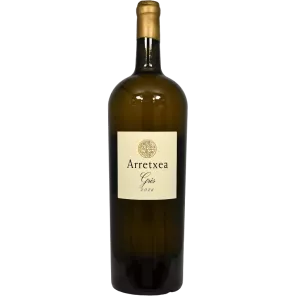
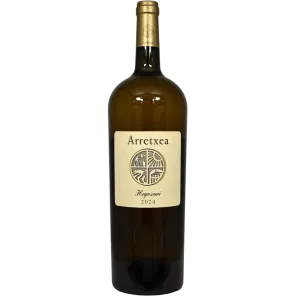
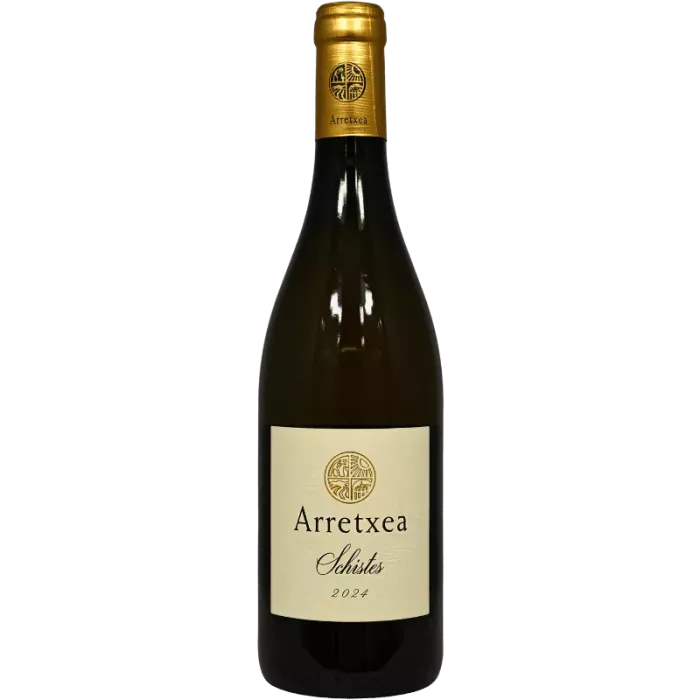
Description: Magnum Schiste white Irouléguy 2024 | Arretxea
At the foot of the Basque Pyrenees, on the heightsof Irouléguy, Domaine Arretxea has been cultivating its vineyards since 1994. Its name, which means “stone house” in Basque, speaks volumes about its mineral roots and a philosophy focused on the essentials. The Schiste cuvée is the most direct white expression of this high-altitude terroir, nestled in the heart of southwestern France.
Terroir and Grape Varieties
The vines, planted in 1994, cling to south-facing schist slopes. This poor, well-drained soil produces concentrated grapes that ripen slowly and in a controlled manner. Yields average around 30 hl/ha in the best years, which remains very low for the appellation. The blend consists of 80% Petit Manseng and 20% Gros Manseng. Petit Manseng contributes tension and minerality; Gros Manseng, fullness and richness. Together, they create a balanced and harmonious dry white wine from the Pyrenees.
Viticulture and Winemaking
The estate has been cultivating its vines using biodynamic methods for several years, though it does not yet hold official certification. The transition to organic farming dates back to 1998 —an early decision made at a time when such practices were still rare in southwestern France. The grapes are harvested by hand. Fermentation takes place in 1,200-liter casks, followed by 10 months of aging in the same containers. An additional year in the bottle precedes release. This extended aging period—and the refusal to rush the process—is Arretxea’s hallmark.
Magnum Schiste white Irouléguy 2024 | Arretxea: The Sommelier’s Review
Philippe Mischler, sommelier at Mundovin
In a lesser-known appellation, often reduced to its reds, this Schiste white is a precious anomaly. A dry Petit Manseng is a high-wire act: the naturally rich grape variety must be restrained, guided toward precision rather than opulence. Arretxea achieves this thanks to the schist soil and extended aging in large oak casks, which allows the wine to integrate without oxidizing. This wine will come into its own between 2026 and 2036: the window is wide, and patience will be rewarded. Serve around 10°C, without decanting, to preserve its mineral tension.
The Nose
The nose opens with ripe citrus—citron and grapefruit—along with a hint of slightly candied apricot. A subtle floral note, almost like white flowers, runs through the entire profile. In the background, the schist-driven minerality settles in, dry and precise, like a stone warmed by the sun.
Palate
On the palate, the attack is full-bodied and generous, driven by the richness of the Petit Manseng. The texture is dense without being heavy. The acidity quickly takes over, structuring the wine with a lovely firmness. The finish is long and briny, with a persistence that recalls the schist-rich terroir. A balance between richness and tension that is not all that common in dry white wines from the Southwest.
Irouléguy: Everything You Need to Know About This Appellation
Irouléguy is the only wine appellation in the French Basque Country. Nestled between the Pyrenees and the Atlantic Ocean, it occupies the steep slopes around Saint-Jean-Pied-de-Port. The soils consist mainly of schist and red sandstone. The climate, which is both oceanic and mountainous, imposes demanding growing conditions. The traditional white grape varieties are Petit Manseng and Gros Manseng, which are vinified as dry wines here—a practice that remains a local specialty.
The Schisted’Arretxea cuvée is representative of the most mineral and taut wines the appellation can produce. The south-facing exposure of the plots, the limited yield, and aging in large oak casks place it among the appellation’s most serious expressions. A dry mountain white wine, Atlantic in its energy, Basque in its character.
 en / €
 Contact


.svg)
.svg)