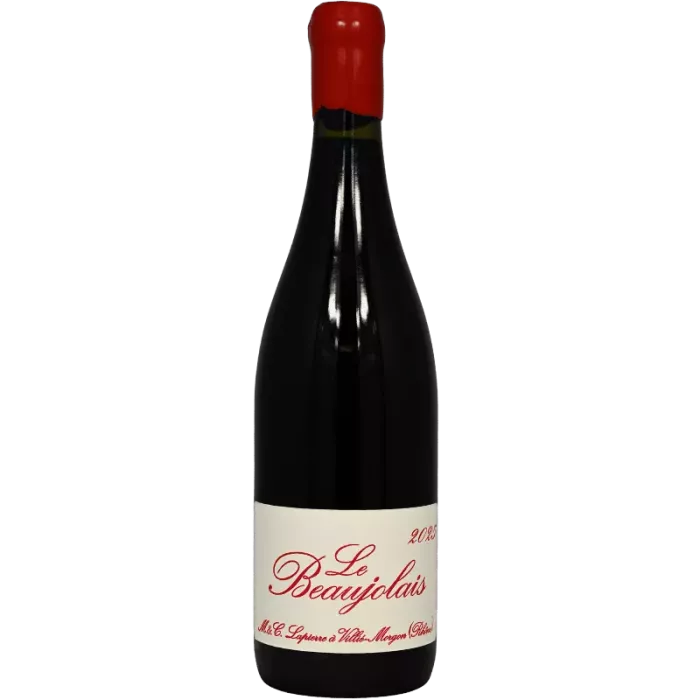
2025 Red Beaujolais | Marcel Lapierre
The 2025 Red Beaujolais from the Marcel Lapierre wine estate is a vibrant introduction to the world of the Lapierre family. This cuvée was created in 2021, distinct from the Morgon for which the wine estate has historically been renowned. It is sourced from three plots located in the commune of Lancié, right on the edge of the village of Morgon. Marcel Lapierre, influenced by Jules Chauvet as early as the 1970s, laid the foundations for a natural style that changed the history of Beaujolais. Today, his children, Mathieu and Camille, carry on this legacy with the same dedication.
Terroir and Grape Variety
The Lancié plots rest on acidic, poor, sandy granitic soils derived from weathered granite. This well-drained soil type forces the vines to send their roots deep into the ground. The result is natural concentration, achieved without artificial intervention. The grape variety is 100% Gamay, sourced from vines ranging from 50 to 80 years old. These old vines yield little, but with an aromatic precision that younger vines have not yet attained.
Viticulture and Winemaking
The wine estate is certified organic farming (AB, Ecocert since 2004). The grapes are harvested by hand, with a late harvest to achieve optimal ripeness. Fermentation follows the Beaujolais semi-carbonic maceration protocol, carried out with indigenous yeasts and without the addition of SO₂, for 10 to 21 days depending on the vintage. Ageing lasts 6 to 7 months in tanks, preserving the fruit’s freshness without oak influence. The 2025 vintage saw a small harvest in the Beaujolais region, marked by flower drop and hail in July. Nevertheless, the balance was remarkable, and the fruit was of rare quality.
2025 Beaujolais Red | Marcel Lapierre: The Sommelier’s Review
Philippe Mischler, sommelier at Mundovin
This Beaujolais holds a special place in the Lapierre lineup. It is not the Morgon, with its depth and mineral tension on the granite of Villié-Morgon. It is something else entirely: a wine that offers immediate pleasure—sincere and unpretentious. The 50- to 80-year-old vines on the weathered granite of Lancié produce a Gamay of a purity and liveliness rarely found at this price point. I recommend serving it slightly chilled, around 15 to 17 °C, after a brief decant. The ideal drinking window is between 2026 and 2029, though it’s already a full pleasure to drink today.
The Nose
The nose opens with bright cherry and fresh raspberry. Wild strawberry rounds out this trio of crisp red fruits. A subtle floral note and a hint of pink pepper add depth without weighing down the overall profile. The finish remains luminous, almost ethereal.
Palate
On the palate, the attack is fresh and direct. The texture is silky and airy, carried by a well-structured yet understated tension. The tannins are very fine, seamlessly integrated into the fruit. The finish is elegant, with a hint of sweet spice that is characteristic of semi-carbonic maceration. A crisp, vibrant wine that requires no effort to enjoy.
Beaujolais: An Appellation with a Distinctive Character
The Beaujolais AOP covers the southern part of the region, south of the crus. It is primarily composed of granitic soils that give the wines their lightness and mineral energy. Gamay is the only red grape variety grown here, expressing—depending on the terroir—a range of flavors from easy-drinking fruitiness to a more structured intensity. The appellation’s wines are known for their juicy character, freshness, and approachability.
Marcel Lapierre’s red Beaujolais fits within this appellation with above-average ambition. The old vines of Lancié, natural winemaking, and organic certification make it a benchmark in its category.
 en / €
 Contact


.svg)
.svg)