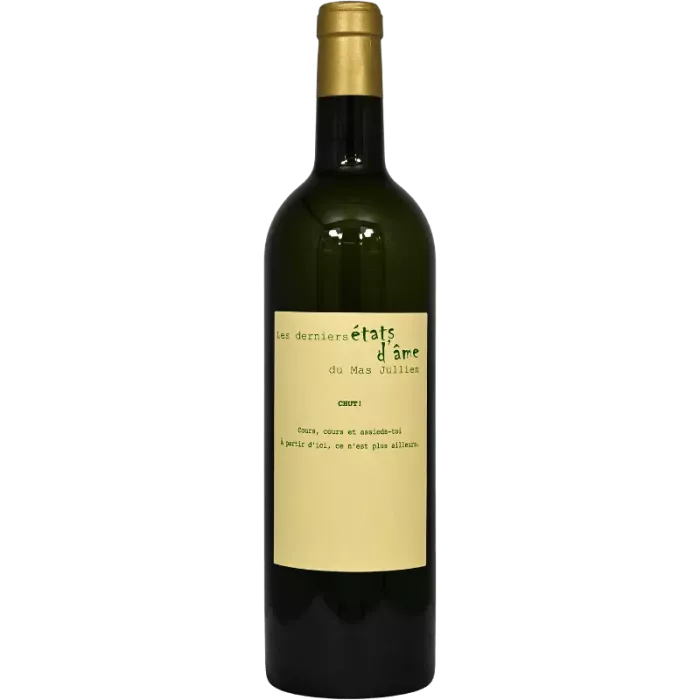
Les Derniers États d'Âme Blanc 2025 | Mas Jullien
At Mas Jullien, each cuvée embodies a specific vision. Les Derniers États d'Âme is perhaps the freest-spirited of them all. ThisPays d'Hérault IGP white wine is born in the Languedoc, where Olivier Jullien has been cultivating the rugged terroirs of the Terrasses du Larzac since the 1980s. The label was conceived as an experimental workshop. Each vintage expresses its own moods and variations from the vineyard plot—its “states of mind.”
Terroirs and Grape Varieties
The blend is composed of three rare grape varieties in this region: Bourboulenc as the primary component, Carignan Blanc, and a touch of Chenin. The plots are scattered across the clay and limestone gravel soils of the Terrasses du Larzac. This well-drained, nutrient-poor soil forces the vines to grow deep into the ground. It shapes a taut structure, underpinned by an underlying minerality that is faithfully reflected in the glass.
Viticulture and Winemaking
Olivier Jullien cultivates his vines according to the principles oforganic farming—though without official certification—using light tillage and treatments based on herbal decoctions. The grapes are harvested by hand at just the right stage of ripeness, followed by slow pressing. Fermentation takes place exclusively with indigenous yeasts. For this 2025 vintage, the Bourboulenc was aged in stoneware jars, while the Carignan Blanc and Chenin were aged in demi-muids, on the lees, without stirring or filtration. Blending takes place before bottling.
Les Derniers États d’Âme Blanc 2025 | Mas Jullien: The Sommelier’s Review
Philippe Mischler, sommelier at Mundovin
Les Derniers États d’Âme is one of Mas Jullien’s most distinctive white wines. It defies the usual conventions of Languedoc whites. It retains a southern density while maintaining a straight-forward character. Its minerality evokes Olivier Jullien’s early cuvées from the 1990s, but with greater precision. It is above all the saline quality—rare to this degree in the appellation—that gives this white wine remarkable vibrancy and true drinkability. Its peak drinking window extends from 2028 to 2033: a few years of cellaring will allow it to refine its structure and reveal its full complexity. Serve around 11°C, without decanting.
The Nose
The nose opens with beautifully crisp floral and herbal notes. Acacia blossom mingles with fresh fennel, a hint of anise, and notes of pine nuts. This is followed by a hint of damp garrigue: lemon thyme, savory, and a subtle peppery note. This aromatic depth never masks the mineral backbone that runs through the wine.
Palate
On the palate, the attack is full-bodied, flavorful, and straightforward all at once. The wine is generous, carried by a natural roundness without excess. The mid-palate is dry and taut, with flavors of citrus zest, fennel, and a sap-like touch reminiscent of star anise. The salty minerality comes through clearly. The finish is long and fresh, with a mouth-watering persistence that leaves the palate tingling.
IGP Pays d’Hérault: An Appellation That Embraces Freedom
The IGP Pays d’Hérault (Protected Geographical Indication) covers a large part of the eponymous department, in the heart of Languedoc. It offers winemakers flexibility in grape varieties and winemaking practices that stricter AOPs do not always allow. It is precisely this flexible framework that allows grape varieties such as Bourboulenc and Carignan Blanc to find their place in a blend. The soils here are varied: clay, limestone gravel, and schist, depending on the subregion.
Les Derniers États d’Âme exemplifies the most ambitious wines the Pays d’Hérault IGP has to offer. Far from being a second-tier offering, this cuvée asserts a strong identity, rooted in the Terrasses du Larzac. It proves that a Languedoc white can combine southern density and mineral tension without compromise.
 Contact
 en / €

.svg)
.svg)