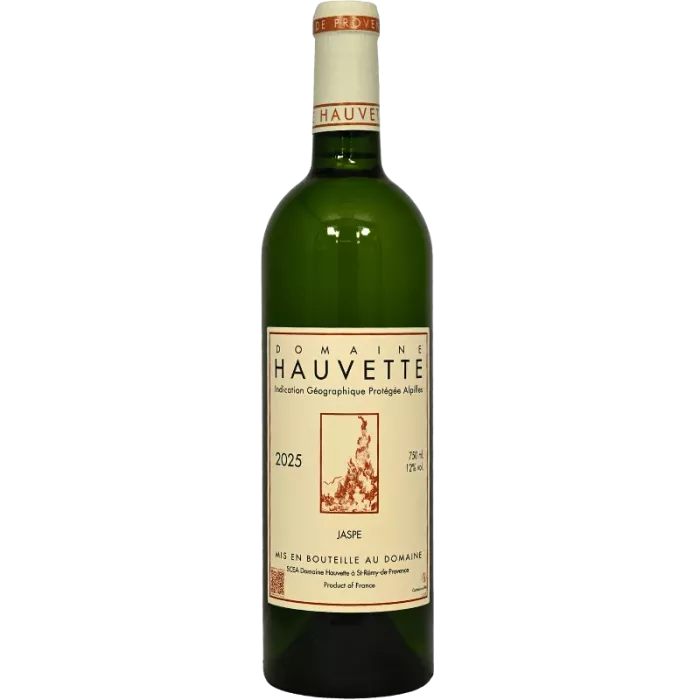
Description of Jaspe 2025 | Domaine Hauvette
The Jaspe cuvée is one of the most distinctive white wines Dominique Hauvette has produced over the past twenty years. Based in Saint-Rémy-de-Provence since 1988, on a 17-hectare wine estate that she cultivates using horses and strict biodynamic methods, the winemaker—who was named Winemaker of the Year 2020 by the Revue des Vins de France —has continually pushed the boundaries of what we thought we knew about Provence wines.
Terroir and Grape Varieties
The vines for the Jaspe cuvée grow on the northern slopes of the Alpilles mountain range, in a rugged and unspoiled landscape. Planted some twenty years ago, they are rooted in rocky, poor, well-drained clay-limestone soils, nestled among the garrigue, rockroses, and holm oaks. This fabulous setting is, in fact, full of challenges for the vines, which draw from this dry soil a natural tension that no human intervention could ever replicate. Here, Roussanne is grown as a single variety to reveal its most lively character: with a stony minerality that almost makes one forget its aromatic richness, it also boasts a complexity and length that stem directly from its unique ageing process.
Viticulture and Winemaking
A proponent of biodynamics from the very beginning, Dominique Hauvette has been certified since 2003. At her estate, the grapes are harvested by hand, and the whole-bunch clusters are meticulously sorted before gentle pressing. Fermentation is driven by indigenous yeasts, without any chemical or oenological additives. Ageing takes place on the lees in concrete eggs—a porous, neutral container that promotes the wine’s micro-oxygenation. The wine expresses itself naturally, unfiltered, and without added sulfites.
Jaspe 2025 | Domaine Hauvette: The Sommelier’s Review
Philippe Mischler, sommelier at Mundovin
The Jaspe cuvée has built a reputation all its own, vintage after vintage. What strikes you when tasting it for the first time is the balance of this Roussanne, whose profile is unlike any other: neither truly opulent nor entirely mineral, it strikes a remarkable balance. In the hands of Dominique Hauvette, it becomes both generous and taut, beautifully capturing all the distinct character of its Alpilles terroir. It is expected to reach its peak drinking period between 2029 and 2032, but the wine is already quite expressive in its youth. A light decanting for half an hour at 10–12°C will open it up even further. At the table, it pairs naturally with rich, slightly bitter dishes: an asparagus fricassee with chanterelles, sweetbreads with morels, or simply a well-aged Comté cheese.
The Nose
The nose opens with an immediate, almost floral freshness. Notes of honeysuckle and hawthorn intertwine with aromas of vine peach and ripe apricot. A hint of lemon leaf adds a subtle herbal note. In the background, flint and a light roasted hazelnut note reflect the terroir of the Alpilles.
Palate
The palate opens with a supple and creamy attack, immediately cut through by a lively, natural acidity. The texture is full-bodied, with a silky mouthfeel. Notes of candied citrus and fresh pineapple emerge on the mid-palate. The retro-olfaction reveals a smoky, flint-like minerality. The finish is salty, long, with delicate, mouth-watering bitter notes.
The Alpilles IGP: A White Wine Terroir Worth Rediscovering
The Alpilles IGP covers a limestone massif in the heart of Provence, between Arles and Salon-de-Provence. The soils here are poor and rocky, exposed to intense sunshine, which is tempered by the Tramontane wind. These conditions produce white wines with marked freshness and pronounced minerality, whose aging potential is often underestimated. Roussanne finds a particularly well-suited terroir here: it gains in tension what it would lose in roundness on more generous terroirs.
The Jaspe cuvée perfectly illustrates this profile unique to the appellation, where it stands out for the masterful artistry of its ageing.
 en / €
 Contact


.svg)
.svg)