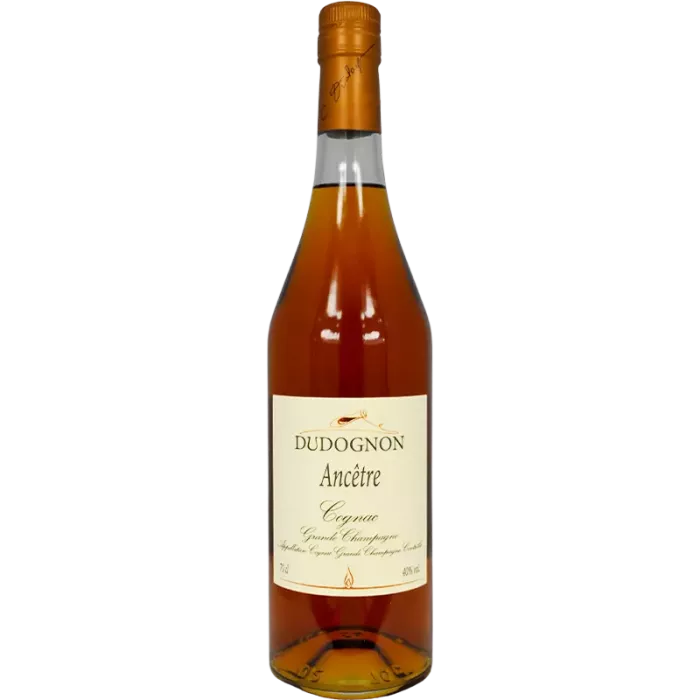
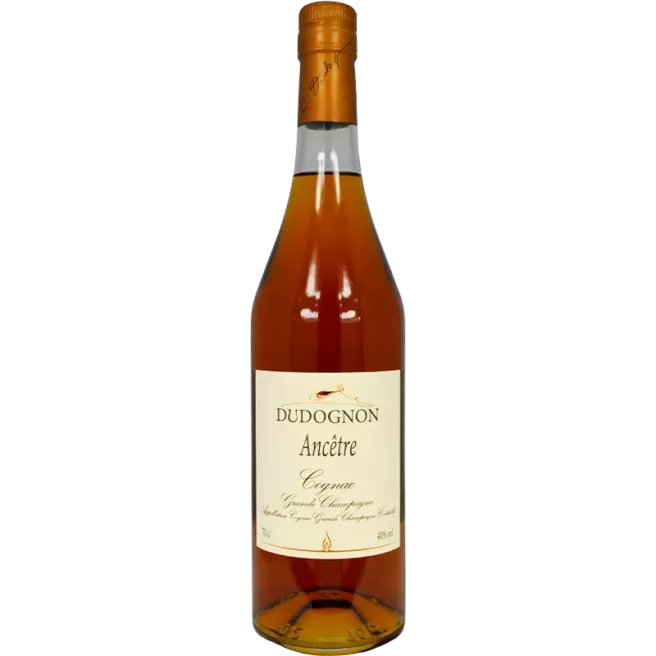
Grande Champagne Ancêtre Cognac | Dudognon
The Grande Champagne Ancêtre Cognac from Maison Dudognon is the culmination of extraordinary patience: some of the eaux-de-vie used to blend it date back to 1900, having passed through nearly four generations before reaching the glass. The Dudognon-Buraud family has been based in the heart of Grande Champagne since 1776. Today, Claudine Dudognon, supported by her husband and their son, carries on this tradition of passing down the craft, always without compromise.
Terroir and Grape Varieties
The family vineyard spans the Davore wine estate in Lignières-Sonneville. The soils consist of Campanian chalk, a very pure, well-draining limestone rock that is low in organic matter. This substrate forces the roots to dig deep, concentrating the expression of the terroir in each cluster. This concentration is the hallmark of Grande Champagne eaux-de-vie, which unfailingly embody the aromatic finesse and exceptional aging potential of this great terroir. The exclusive grape variety isUgni Blanc, the dominant variety in the appellation and known for producing light, acidic base wines that are ideal for double distillation.
Viticulture and Winemaking
For generations, the house’s philosophy has emphasized winemaking and distillation where craftsmanship reigns supreme. The eaux-de-vie contain no additives, no artificial flavors, and no colorants. Double distillation in wood-fired pot stills follows the ancestral Charente method, while the Limousin oak barrels are crafted from staves that have been air-dried for approximately three years. Ageing lasts at least 30 years, with some of the eaux-de-vie in the blend well over a century old. The final product is bottled without cold filtration to preserve the full, remarkable complexity of the spirit.
Grande Champagne Ancêtre Cognac | Dudognon: The Sommelier’s Review
Philippe Mischler, sommelier at Mundovin
At Dudognon, everything comes from the family’s vineyards in Davore. Here, time becomes a true raw material, permeating every component of the blend. Few houses can claim to have century-old eaux-de-vie from a single family vineyard, without additives or artificial enhancements. The gold medal won in 1990 at the International Spirits Tasting Show recognized this work, but the cuvée needs no awards to win you over. Serve at 18°C in a tulip-shaped glass that concentrates the aromas without smothering them, paired with a dessert featuring notes of fine spices or dark chocolate.
The Nose
The nose opens with white flowers and summer herbs—fresh and slightly grassy. Then come coffee, chocolate, and vanilla, notes typical of a long aging in oak barrels. The finish reveals aged leather, pipe tobacco, sandalwood, and a remarkable hint of forest floor. It is a nose of great complexity, revealing its successive layers one by one.
On the palate
On the palate, the attack is powerful and direct. The body is full and dense, supported by a silky texture that only very long ageing can produce. The balance is remarkable: nothing dominates; everything blends together. The finish is long—very long—with notes of coffee, vanilla, dried fruit, and sandalwood. It lingers long after the glass has been set down.
Grande Champagne: Everything You Need to Know About This Appellation
Grande Champagne is the first and oldest of the defined appellations in the Cognac region, in southwestern France. Its chalky limestone soils are at the heart of its identity: highly porous and low in organic matter, they force the roots to grow deep and concentrate the terroir’s expression in the grapes. The eaux-de-vie produced from this cru are renowned for their aromatic finesse, complexity, and ability to age for several decades. The dominant grape variety is Ugni Blanc.
Dudognon’s“L’Ancêtre” is a vibrant tribute to this chalky terroir. The blend reveals everything that makes Grande Champagne unique: an extraordinary aromatic length, a finesse that remains unwavering with age, and a complexity built up over decades. It is as much a collector’s item as it is a spirit to be savored.
 Contact
 en / €

.svg)
.svg)